

The praying mantis usually symbolizes patience, focus, and calm before decisive action. In Japan, the kamakiri is also tied to autumn and to boldness: the idiom tōrō no ono, the mantis's axe, describes standing up to a far stronger opponent, and mantis forms appear in Japanese art and design. This guide to praying mantis symbolism starts with the meanings shared around the world and then turns to Japan.
Key Takeaways
- The praying mantis symbolizes patience, focus, and calm before decisive action globally.
- In Japan, the kamakiri (praying mantis) is associated with autumn and is a symbol of courage.
- The idiom tōrō no ono (the mantis's axe) praises or warns against standing up to a stronger opponent.
- The mantis is a kigo (season word) in haiku, representing the autumn season.
- Mantis motifs appear in Japanese art and design, often paired with bamboo or autumn grasses.
Table of Contents
- What Does a Praying Mantis Symbolize?
- The Kamakiri in Japanese Culture
- Courage and the Idiom of the Mantis's Axe
- The Mantis as an Autumn Symbol in Japan
- Mantis Motifs in Japanese Art and Clothing
- Is a Praying Mantis Good Luck?
- Frequently Asked Questions
What Does a Praying Mantis Symbolize?
The praying mantis is widely recognized for its symbolic meanings, which often revolve around patience, stillness, focus, and mindfulness. The name "praying" comes from the mantis's folded front legs, which appear as if in prayer. This posture is seen as a metaphor for preparation and readiness before taking decisive action. Across cultures, the mantis is often associated with calm and deliberate movement, making it a symbol of presence and mindfulness.
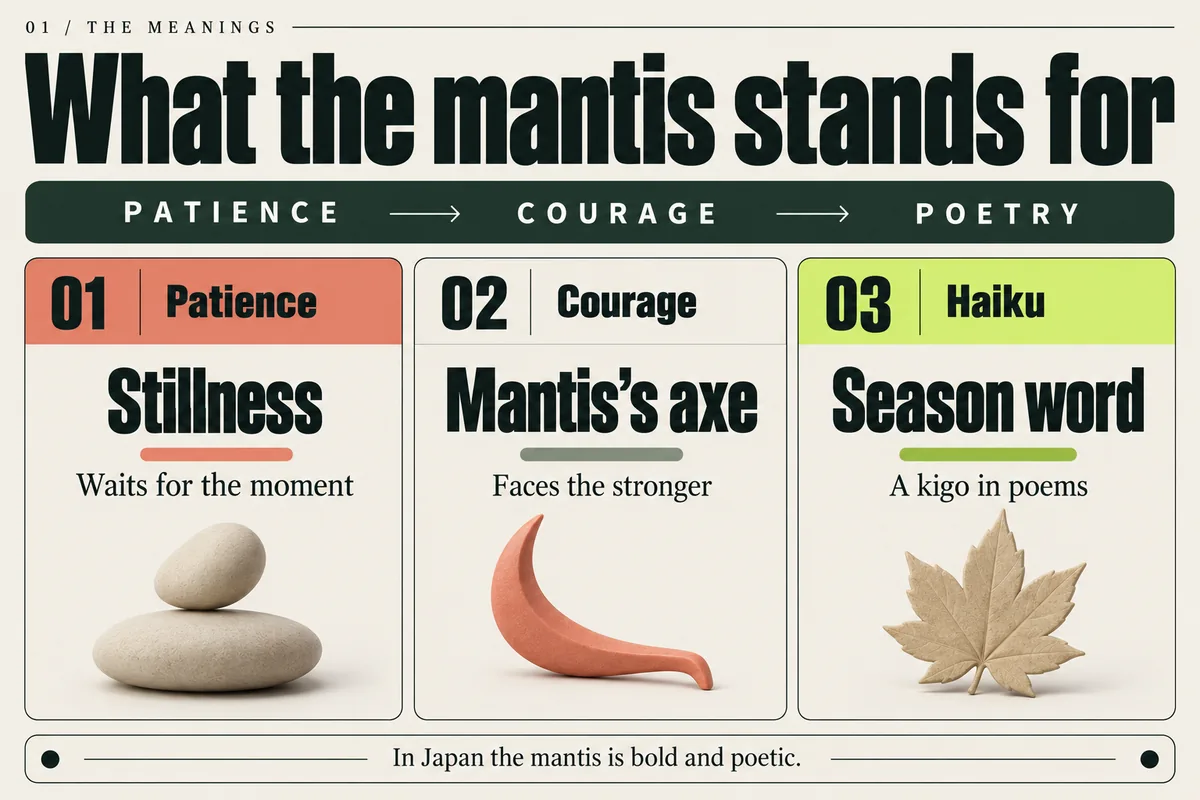
In many spiritual and philosophical traditions, the praying mantis is seen as a reminder to stay grounded and focused, even in chaotic environments. Its ability to remain still for long periods before striking with precision is a powerful metaphor for the importance of patience and preparation in achieving one's goals. These modern spiritual readings, though, are not rooted in documented tradition; they are contemporary interpretations that emphasize mindfulness and presence.
The mantis's stillness while hunting gives rise to the idea of patience. This stillness is not just physical but also mental, symbolizing the need to wait for the right moment to act, a quality that is highly valued in many cultures.
The Kamakiri in Japanese Culture
In Japanese, the praying mantis is known as kamakiri (カマキリ, 蟷螂), a name often explained as "sickle cutter" due to its sickle-like forelegs. The kamakiri has a rich presence in Japanese culture, appearing in literature, art, and folklore. Its significance is multifaceted, reflecting both natural and cultural observations.
One of the most notable aspects of the kamakiri in Japanese culture is its association with autumn. As a kigo, or season word, in haiku, the kamakiri is a symbol of the fall season, when adult mantises are most visible in fields and gardens. This seasonal connection highlights the mantis's role as a harbinger of change and the fleeting nature of time.
Gardeners in Japan often welcome mantises because they prey on other insects, helping to maintain a balanced ecosystem. The sickle-like forelegs of the mantis not only give it its name but also contribute to its fearsome reputation as a skilled hunter.
Seeing a Mantis in Autumn
Encountering a mantis in autumn can be a gentle personal reading, connecting to the Japanese tradition of season words. The mantis, as a kigo, signals the arrival of autumn, a time of reflection and change. Seeing one might be a subtle reminder to embrace the season's transient beauty and the importance of adapting to the shifts in life.
Courage and the Idiom of the Mantis's Axe
The idiom tōrō no ono (蟷螂の斧, the mantis's axe) is a powerful expression that has its roots in Chinese classical literature, particularly the Zhuangzi. The idiom describes a mantis raising its forelegs against a carriage, symbolizing a weak party standing up to a far stronger one. This idiom was adopted into Japanese and is used to describe acts of courage or, depending on the context, acts of reckless defiance.
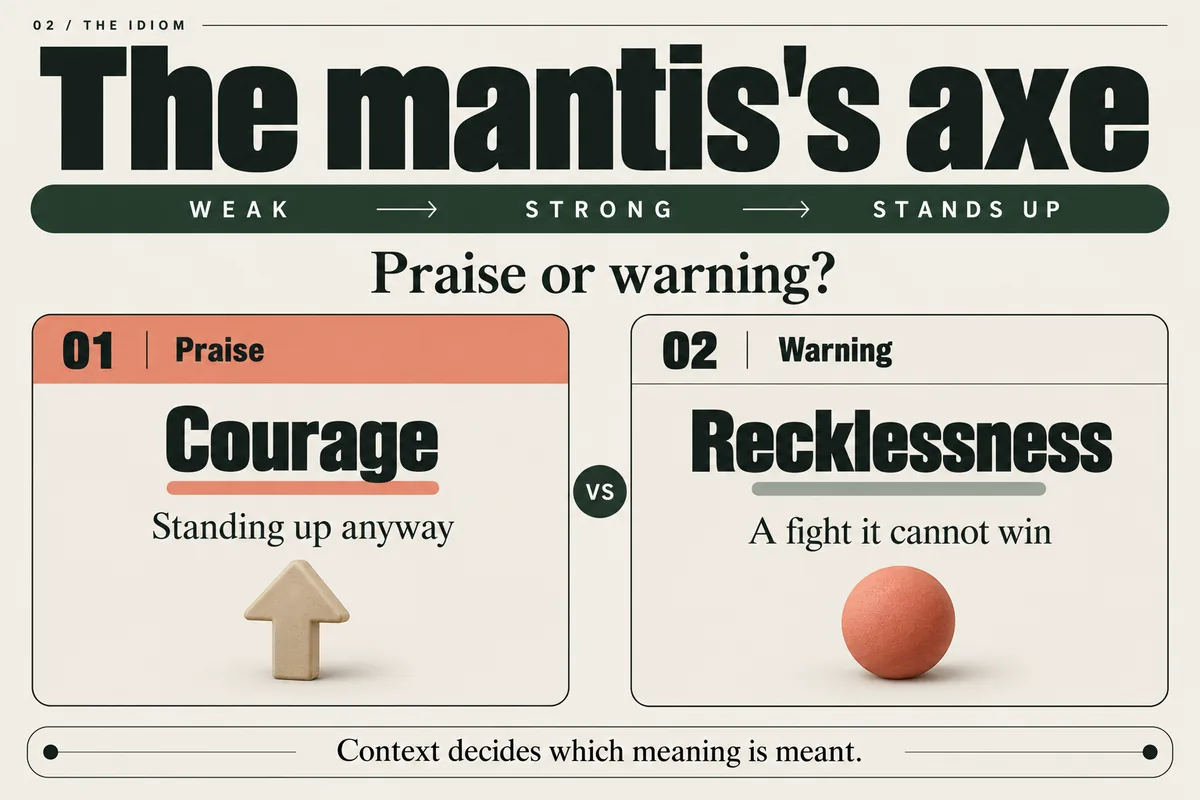
The idiom can be both praising and cautionary. On one hand, it can honor the bravery of those who stand up to overwhelming odds. For example, a small shop facing a giant chain might be described as raising its mantis's axe, showing its determination to survive against all odds. Similarly, a rookie challenging a champion in a competition might be seen as raising the mantis's axe, demonstrating their courage and resolve. On the other hand, it can warn against taking on battles that are clearly unwinnable. This dual nature reflects the complex interplay of courage and prudence in Japanese culture.
The Mantis as an Autumn Symbol in Japan
The mantis's role as an autumn symbol in Japan is deeply rooted in the natural cycle of the seasons. Adult mantises are most visible in the fall, making them a common sight in gardens and fields during this time. This seasonal presence has made the kamakiri a popular subject in Japanese poetry, particularly in haiku, where it is used to evoke the transient beauty of autumn.
The mantis's appearance in the fall also aligns with the Japanese appreciation for the changing seasons and the fleeting nature of life. This connection to autumn reinforces the mantis's symbolism of patience, focus, and the importance of making the most of the present moment.
Haiku poets use season words to set a scene in very few syllables. The mantis, as a kigo, places a poem firmly in the autumn season, evoking the crisp air, the golden leaves, and the sense of impending change.
Mantis Motifs in Japanese Art and Clothing
In Japanese art and design, the mantis appears as a motif of boldness and courage. Often paired with bamboo or autumn grasses, the mantis is a symbol of strength and resilience. This design motif can be found in various forms of Japanese art, including paintings, textiles, and even on traditional clothing.
The mantis pairs well with bamboo because both are upright, green, and often associated with autumn gardens. The Kachimushi Dragonfly Victory Sukajan, for instance, features an ink-navy background with three rising dragonflies diagonally across the back and a smaller one at the left chest, all embroidered in iridescent blue-green thread. The dragonfly, known as kachimushi or the victory insect, symbolizes courage and success. Another example is the Luna Moth & Night Peony Sukajan, which has a black background with a large luna moth centered on the back and a night-blooming peony below, both embroidered in pale jade and dusty rose thread. These designs highlight the mantis's role in a broader ecosystem of autumnal and nocturnal motifs.
One example of the mantis motif in Japanese clothing is the Kamakiri Mantis & Bamboo Sukajan by Sukaizen. This sukajan features a praying mantis in profile on a single bamboo cane at mid-back, with leaf sprays on both sleeves. The design is machine embroidered with bone and jade thread, set against a rayon satin shell and viscose lining. The mantis motif, along with other traditional designs, reflects the enduring significance of these symbols in Japanese culture.
How to Wear a Mantis Motif
Wearing a mantis motif can be a bold statement of courage and resilience. Pair a bold back embroidery with plain trousers and a simple tee to let the intricate design stand out. For a more subtle look, a bone and jade jacket can complement autumn colors, adding a touch of elegance to your outfit. Let one mantis motif lead the way, creating a harmonious balance between boldness and simplicity.
Is a Praying Mantis Good Luck?
The interpretation of a praying mantis sighting as good or bad luck varies across different cultures. Many cultures view the mantis as a positive sign, symbolizing stillness, patience, and a reminder to pause and reflect. In some old European folk beliefs, the mantis was even seen as a guide.
However, there is no single rule when it comes to the mantis's symbolism in terms of luck. The mantis's presence can be interpreted in various ways depending on personal beliefs and cultural context. For some, seeing a mantis might be a sign to stay focused and prepared, while for others, it might be a gentle reminder to take a moment of stillness in a busy life.
Seeing a Mantis in Autumn
Encountering a mantis in autumn can be a gentle personal reading, connecting to the Japanese tradition of season words. The mantis, as a kigo, signals the arrival of autumn, a time of reflection and change. Seeing one might be a subtle reminder to embrace the season's transient beauty and the importance of adapting to the shifts in life.
Frequently Asked Questions
Are praying mantises good or bad omens?
Praying mantises are generally considered good omens in many cultures, symbolizing patience, focus, and mindfulness. They are often seen as a positive sign, encouraging stillness and reflection. In Japanese culture, the mantis is particularly associated with autumn and courage, making it a symbol of the changing seasons and the strength to face challenges.
Is a praying mantis good or bad?
A praying mantis is typically seen as a good sign, representing patience, focus, and calm before decisive action. However, interpretations can vary based on personal and cultural beliefs. In Japan, the mantis is often associated with autumn and the idiom tōrō no ono, which can be both a praise for courage and a caution against reckless defiance.
Is it rare to see a praying mantis?
While mantises are common in gardens during the summer and autumn, their camouflage makes them easy to miss. Therefore, seeing one is not particularly rare, but it can still be a notable experience. In Japanese culture, encountering a mantis in autumn can be a gentle reminder of the changing seasons and the importance of staying grounded and focused.
What does it mean if a praying mantis is hanging around your house?
If a praying mantis is hanging around your house, it might be seen as a positive sign, symbolizing patience, focus, and a reminder to stay grounded. Some cultures interpret it as a guide or a sign of good luck. In Japan, it could be a subtle reminder to embrace the transient beauty of autumn and the importance of adapting to change.
Conclusion
The praying mantis, or kamakiri, is a symbol of patience, focus, and calm before decisive action. In Japan, it is also associated with autumn and courage, as embodied in the idiom tōrō no ono. Whether seen as a positive omen or a reminder to stay grounded, the mantis's presence in Japanese culture and art reflects its enduring significance.


