

A kamon is a Japanese family crest, a simple emblem usually set in a circle that identifies a household. Nobles used them from the Heian period, samurai put them on banners and armor, and today almost every Japanese family has one, worn on formal kimono and used in logos.
Key Takeaways
- Origin: Family crests originated in the Heian period and were widely used by samurai and nobility.
- Famous Crests: The 16-petal chrysanthemum is the imperial crest, and the three-leaf hollyhock is the Tokugawa shogunate's crest.
- Motifs: Common motifs include wisteria, kikyo bellflower, and cranes, each carrying symbolic meanings.
- Finding Your Crest: Older relatives, family formal kimono, and gravestones are key sources for discovering your family crest.
- Modern Use: Family crests appear on formal kimono and contemporary streetwear, blending tradition with modern fashion.
Table of Contents
- What Is a Japanese Family Crest?
- From Heian Nobles to Samurai Banners: A Short History
- Famous Crests: Chrysanthemum, Hollyhock and Paulownia
- Common Crest Motifs and What They Mean
- Family Crests vs European Coats of Arms
- How to Find Your Family Crest
- Crests on Clothing: From Montsuki to Modern Streetwear
- Frequently Asked Questions
What Is a Japanese Family Crest?
A family crest, or Japanese family crest, is a simple emblem that traditionally represents a household. These crests are often circular and are used to identify family lineage and heritage. They have a rich history dating back to the Heian period, where they were first used by court nobles on carriages and clothing. Over time, their use expanded to include samurai, who adorned their banners and armor with these emblems to distinguish themselves on the battlefield.
By the Edo period, the use of family crests had become widespread, adopted by merchants, actors, and ordinary families. Today, almost every Japanese family has a crest, which is often featured on formal kimono, family graves, and other personal items.
From Heian Nobles to Samurai Banners: A Short History
The history of family crests is deeply intertwined with Japanese culture and history. During the Heian period (794-1185), court nobles began using these emblems on carriages and clothing to denote their status and lineage. These early crests were simple and elegant, often featuring natural elements like plants and animals.
By the 12th century, the use of family crests had spread to the samurai class. Samurai warriors adopted these emblems to distinguish themselves on the battlefield, where they were crucial for identifying allies and enemies. Crests were prominently displayed on banners, armor, and tents, serving both practical and symbolic purposes.
During the Edo period (1603-1868), the use of family crests became even more widespread. Merchants, actors, and ordinary families began to adopt these emblems, leading to a proliferation of unique and diverse designs. This period saw the codification and standardization of many family crests, with a 2004 reference work listing 241 categories and 5,116 individual mon.
Famous Crests: Chrysanthemum, Hollyhock and Paulownia
One of the most iconic family crests is the 16-petal chrysanthemum, which serves as the imperial crest of Japan. This crest symbolizes the emperor and the imperial family, and it is deeply revered. The chrysanthemum is associated with longevity, rejuvenation, and the imperial line, and it is featured on the imperial seal and official government documents. For more on what the chrysanthemum stands for in Japan, its meaning reaches beyond the imperial seal.
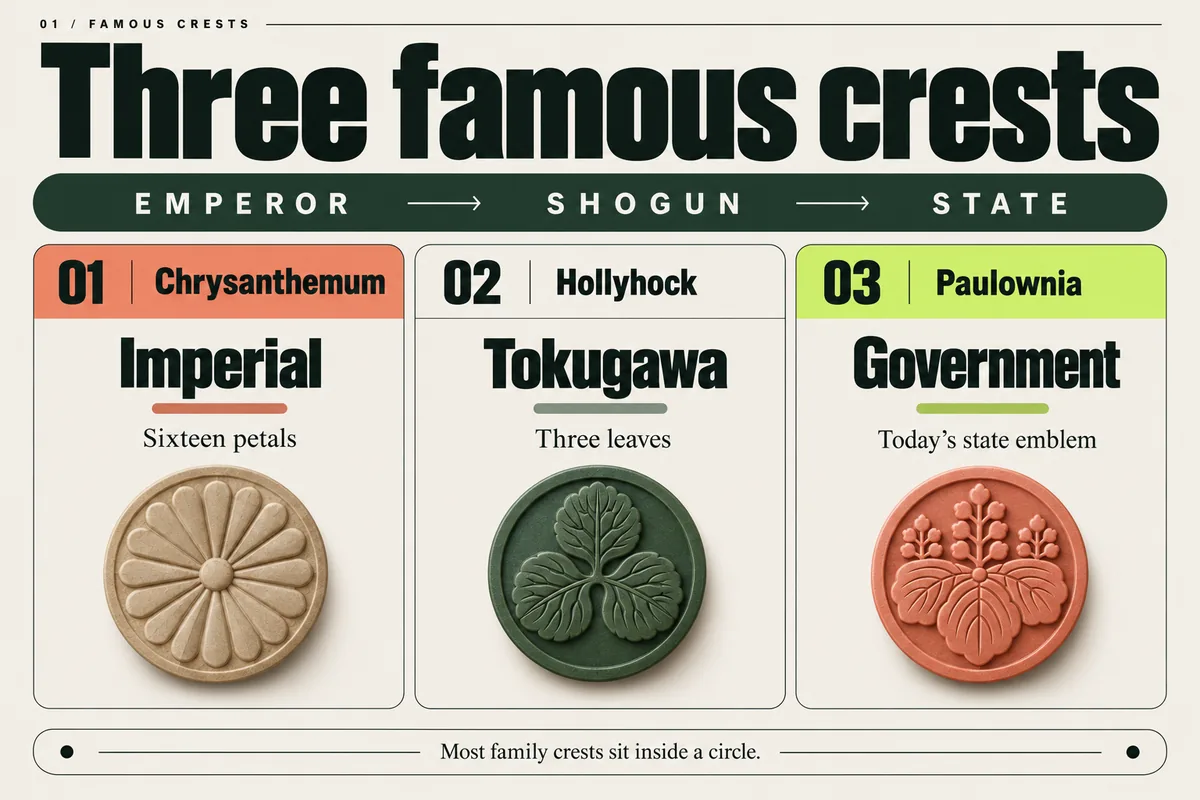
The three-leaf hollyhock (aoi) is another famous crest, belonging to the Tokugawa shogunate. The Tokugawa family ruled Japan during the Edo period, and their crest is a symbol of power and authority. The aoi is often associated with strength, resilience, and the enduring nature of the Tokugawa regime.
The paulownia (kiri) is another significant crest, used today as the emblem of the Japanese government. The paulownia is a symbol of regrowth and prosperity, and it is often featured on official government seals and documents. Each of these crests carries deep cultural and historical significance, reflecting the values and traditions of the families they represent.
Common Crest Motifs and What They Mean
Family crests often feature motifs that carry symbolic meanings. Here are some common motifs and their significance:
- Motif: Wisteria (Fuji) - Associated with the Fujiwara family, wisteria symbolizes long life and prosperity.
- Motif: Kikyo Bellflower - The kikyo bellflower is associated with the Akechi clan and represents constancy and devotion.
- Motif: Plum Blossom - The plum blossom is a symbol of resilience and perseverance, blooming even in the harshest winter conditions.
- Motif: Tomoe Swirls - These spiral motifs are often associated with the Taira clan and represent the cycle of life and death.
- Motif: Crossed Hawk Feathers - This motif is associated with the Minamoto clan and symbolizes bravery and strength.
- Motif: Ginkgo Leaves - Ginkgo leaves are a symbol of longevity and resilience, often featured in family crests.
These motifs are not only beautiful but also carry deep cultural and personal meanings. For example, the kikyo bellflower embroidered haori, a traditional Japanese coat, features sprays of the bellflower from the left chest to the hem, symbolizing constancy and devotion.
Family Crests vs European Coats of Arms
While both family crests and European coats of arms serve to identify lineage and heritage, there are significant differences between the two. A family crest, or mon, is a simple, often circular emblem that is widely used in Japan. These crests are typically unregulated, with the exception of imperial crests, and are found on formal kimono, banners, and gravestones.
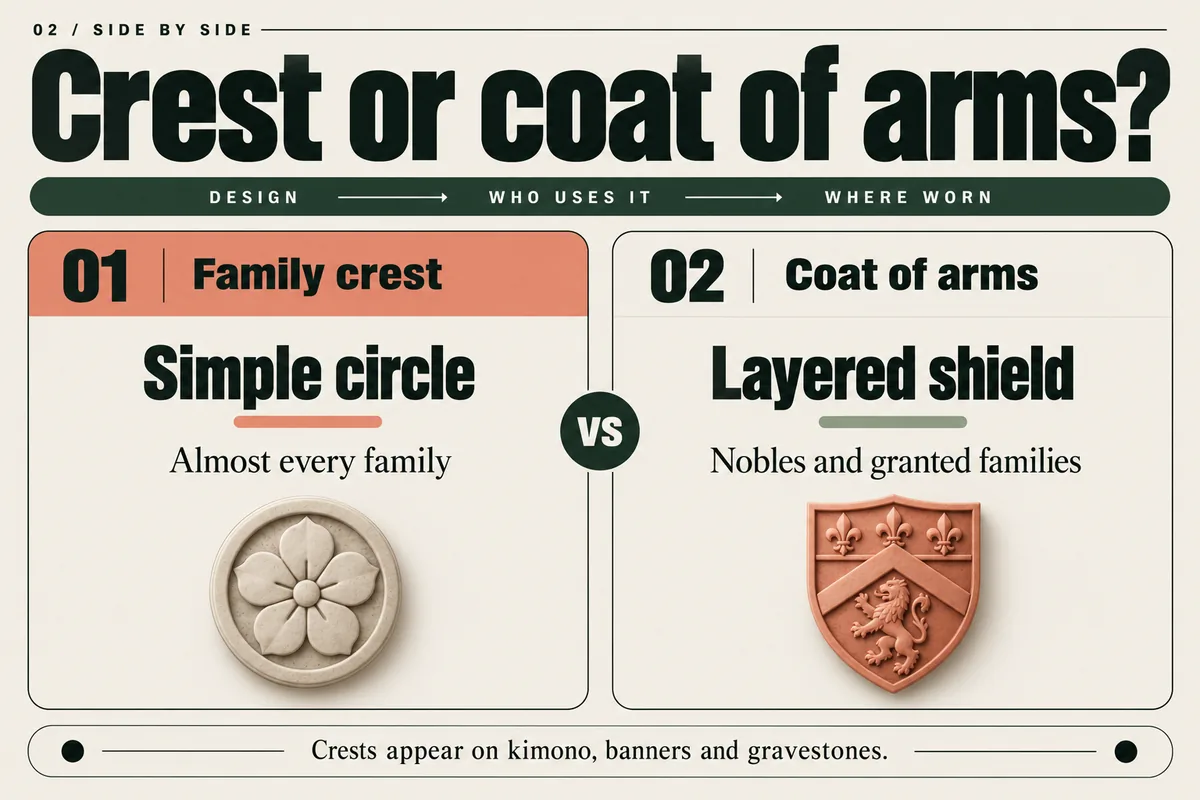
| Feature | Family crest | European coat of arms | |---|---|---| | Design | Simple, often circular emblem | Shield with layered heraldic elements | | Who uses it | Almost every family | Historically nobles and granted families | | Regulation | Mostly unregulated (imperial crests excepted) | Granted under heraldic authority in some countries | | Where worn | Formal kimono, banners, gravestones | Shields, seals, buildings |
In contrast, a European coat of arms is a more complex and layered design, featuring a shield with various heraldic elements. Coats of arms were historically held by nobles and granted families, and they are regulated under heraldic authority in some countries. The simplicity and widespread use of family crests in Japan make them a unique and integral part of Japanese culture.
How to Find Your Family Crest
Discovering your family crest can be a rewarding journey that connects you to your heritage. Here are five steps to help you find your family crest:
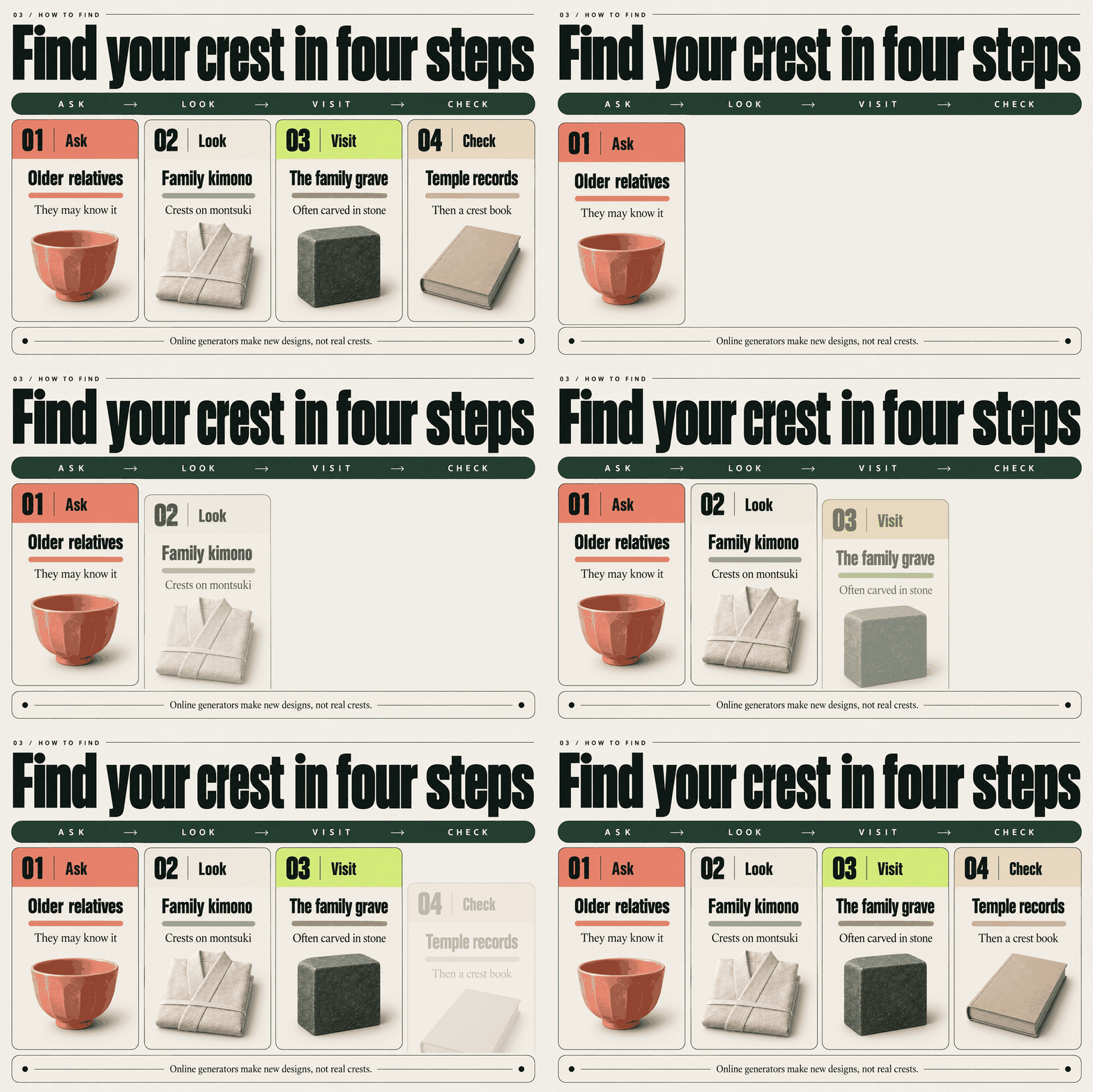
- Ask Older Relatives: Start by asking older family members if they know about the family crest. They may have valuable information or family heirlooms that feature the crest.
- Look at Family Formal Kimono: Check if your family has any formal kimono (montsuki) or haori with the crest embroidered on them. These garments often carry the family emblem.
- Check the Family Grave or Gravestone: Family graves and gravestones often have the crest carved into them. Visit the family grave to see if the crest is present.
- Ask the Family's Buddhist Temple: Buddhist temples sometimes keep records of family crests and may be able to provide information.
- Compare with a Crest Reference Book: Once you have potential leads, compare them with a crest reference book to confirm the authenticity of the crest.
Online crest generators can create new designs but are not reliable for finding a real family crest. These generators can be useful for inspiration but should not be relied upon for historical accuracy.
Crests on Clothing: From Montsuki to Modern Streetwear
Family crests have a long history of being featured on traditional Japanese clothing, particularly formal kimono. Montsuki, a type of formal kimono, often carry one, three, or five crests, with five crests (back, both sleeves, both chest sides) being the most formal. These garments are worn on special occasions and ceremonies, symbolizing family pride and heritage.
Wearing a family crest respectfully is important. It is considered disrespectful to wear another family's crest or the imperial crest as if it were your own. Original crest-style designs, like those found on modern streetwear, are a safe and respectful way to enjoy the aesthetic of these emblems. For example, the crest chenille varsity jacket features a large original crest-style chenille patch on the back, designed to evoke the traditional look without representing any real family's crest.
In contemporary fashion, family crests continue to inspire new designs. The michiyuki coat with kiku chrysanthemum, for instance, features chrysanthemum sprays machine embroidered in ivory and gold thread at the lower left front and across the back hem, blending traditional motifs with modern style.
Frequently Asked Questions
What does kamon mean?
The term means "family crest": ka is the house or family and mon is a crest or emblem. A family crest is a simple design, usually set inside a circle, that identifies one household and its line. Nobles began using crests in the Heian period, samurai carried them on banners and armor, and almost every Japanese family has one today. You will see them on formal kimono, on gravestones and on the banners and logos of old businesses.
What is kamon in English?
In English it is called a Japanese family crest, or simply a mon. Its role is close to a European coat of arms, but the design is far simpler: one emblem, often a plant, animal or geometric shape inside a ring, rather than a shield with layered heraldic parts. Another difference is who holds one. Coats of arms were historically limited to nobles and granted families, while almost every Japanese family has a crest of its own.
How do you say kamon?
Say it roughly as kah-mohn, with two short, even syllables and no strong stress on either one. The first part rhymes with the start of "car", and the second sounds like "moan" said quickly. The second half, mon, is also used on its own to mean a crest or emblem, so you may hear people say mon when they talk about crests on kimono, banners or gravestones. Both forms refer to the same family emblem.
How do you find your Japanese family crest?
To find your Japanese family crest, start by asking older relatives, looking at family formal kimono (montsuki), checking the family grave or gravestone, and asking the family's Buddhist temple. You can also compare your findings with a crest reference book. Online crest generators can create new designs but do not reveal a real family crest. These generators are useful for inspiration but should not be relied upon for historical accuracy.
Conclusion
A kamon, or Japanese family crest, is a simple emblem that represents a household and has a rich history dating back to the Heian period. From the imperial chrysanthemum to the paulownia, these crests carry deep cultural and personal meanings. Discovering your family crest can be a rewarding way to connect with your heritage, and modern fashion continues to draw inspiration from these symbols.


