

A koi can make a small detail feel deliberate or turn the back of a jacket into the main event. Choosing koi fish clothing starts with a useful distinction: the carp has a documented place in stories and Japanese gift imagery, while many familiar claims about its colors and swim direction come from newer interpretations. Neither approach has to limit what you wear. It helps to know which meaning you are drawing on, then choose a motif that suits the space, color, and attention you want it to have.
Key Takeaways
- The Dragon Gate story: The Dragon Gate story links a carp swimming upstream and becoming a dragon with perseverance and achievement.
- Documented colors are about family: A documented Japanese carp color convention concerns family roles on festival streamers, not universal meanings such as red for love or gold for wealth.
- Downstream is a modern reading: A downstream koi can carry a personal meaning, but “letting go” is a modern tattoo interpretation rather than a documented traditional rule.
- Placement sets visibility: Check motif placement from the distance at which people will see the garment: a detailed back design and a small pocket detail serve different purposes.
- Reversible means two choices: On a reversible jacket, consider whether you would wear both sides before paying for that flexibility.
What Koi Fish Clothing Draws On: The Dragon Gate Story
The strongest historical reading behind a koi motif is about striving toward an achievement. The Cleveland Museum of Art describes a Meiji-period embroidered gift cover, or fukusa, showing carp in waves. According to the museum, the carp motif is Chinese in origin. “Carp jumping over the Dragon Gate” referred to success in life, historically including success in imperial civil service examinations. In Japan, a cover with this motif suited a gift celebrating someone’s achievements. That gives a wearer a grounded meaning to draw on without treating every fish design as a coded message.
Cooper Hewitt connects the motif to the Chinese tale through a Kangxi-era vase decorated with red carp. In the story it describes, a carp swims upstream to the falls at Longmen, the Dragon Gate, leaps them, and becomes a dragon. The museum identifies perseverance as the carp’s symbolic quality. On clothing, waves, an upward curve, or a paired dragon can evoke that story, but the garment does not need to illustrate every part of it. Sometimes the most useful reading is simply that the fish suggests effort in motion.
How Koi Reached Japanese Gifts and Festivals
Carp also appear as koinobori, the streamers associated with Children's Day. According to nippon.com, the streamers date to the Edo period and were first flown for Tango no Sekku. The source records changes in carp streamer colors over time: around the late 1800s to early 1900s, black commonly represented the father and red the son; from the 1970s, red came to represent the mother and blue the children. Those are family roles in a festival custom, not evidence that black means overcoming hardship or blue means calm wherever a koi appears.
How Color Changes the Meaning, and Who Decided It
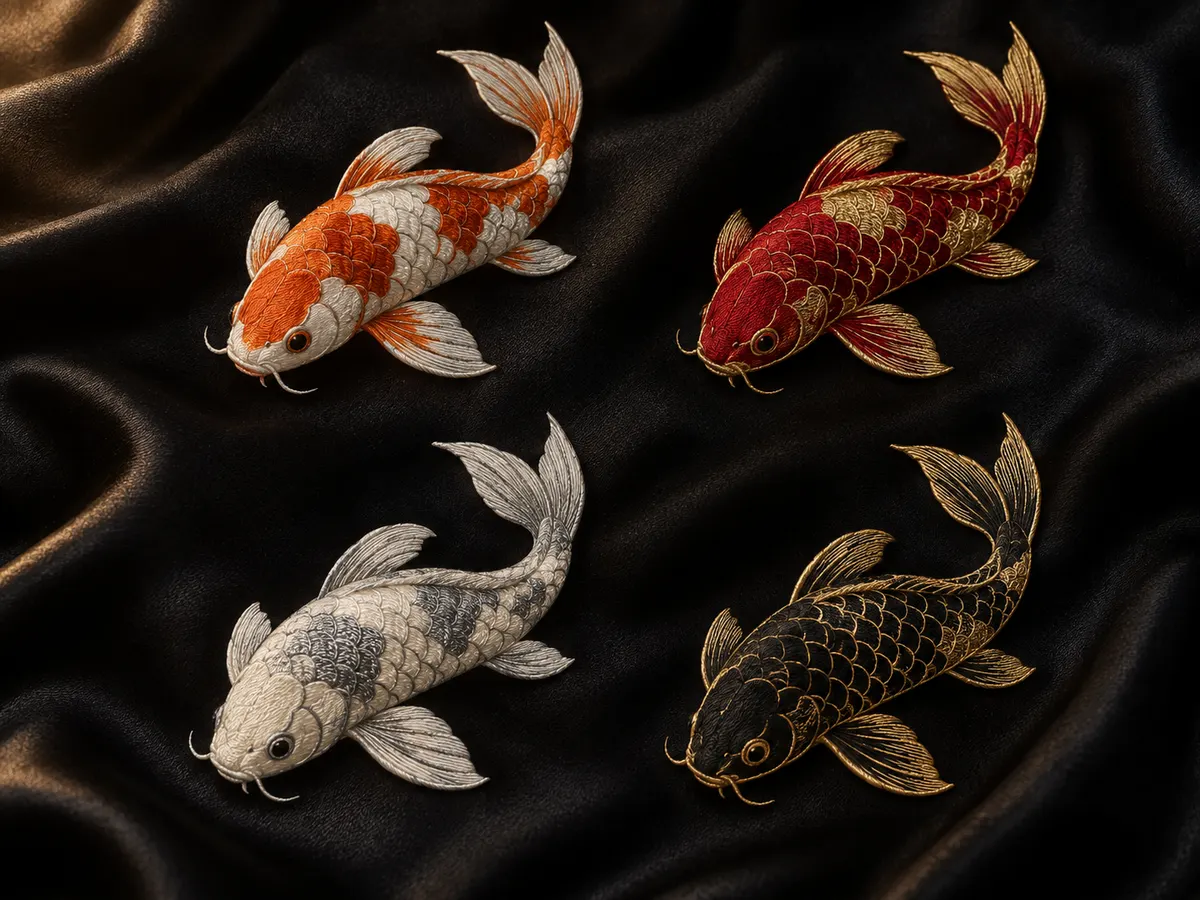
Color changes how a koi motif feels on a garment, but it does not give every fish a fixed definition. Claims such as “red means love,” “gold means wealth,” or “white means purity” may appear in modern tattoo discussions and personal design descriptions. They can be useful if an artist or wearer chooses them, yet they should be presented as that person's convention. The documented streamer colors above describe family roles in a specific setting; they do not establish a general code for koi clothing.
Start with what color does visibly. A pale fish against black cloth will read clearly from farther away. Rust and gold thread on ecru denim can feel quieter than the same colors on black. Several fish in contrasting colors may create movement across a large back panel, while two small fish in one muted color can stay close to a pocket without taking over the shirt. These are design judgments you can make by looking at the piece, without relying on a symbolic chart.
Upstream or Downstream: Reading Swim Direction
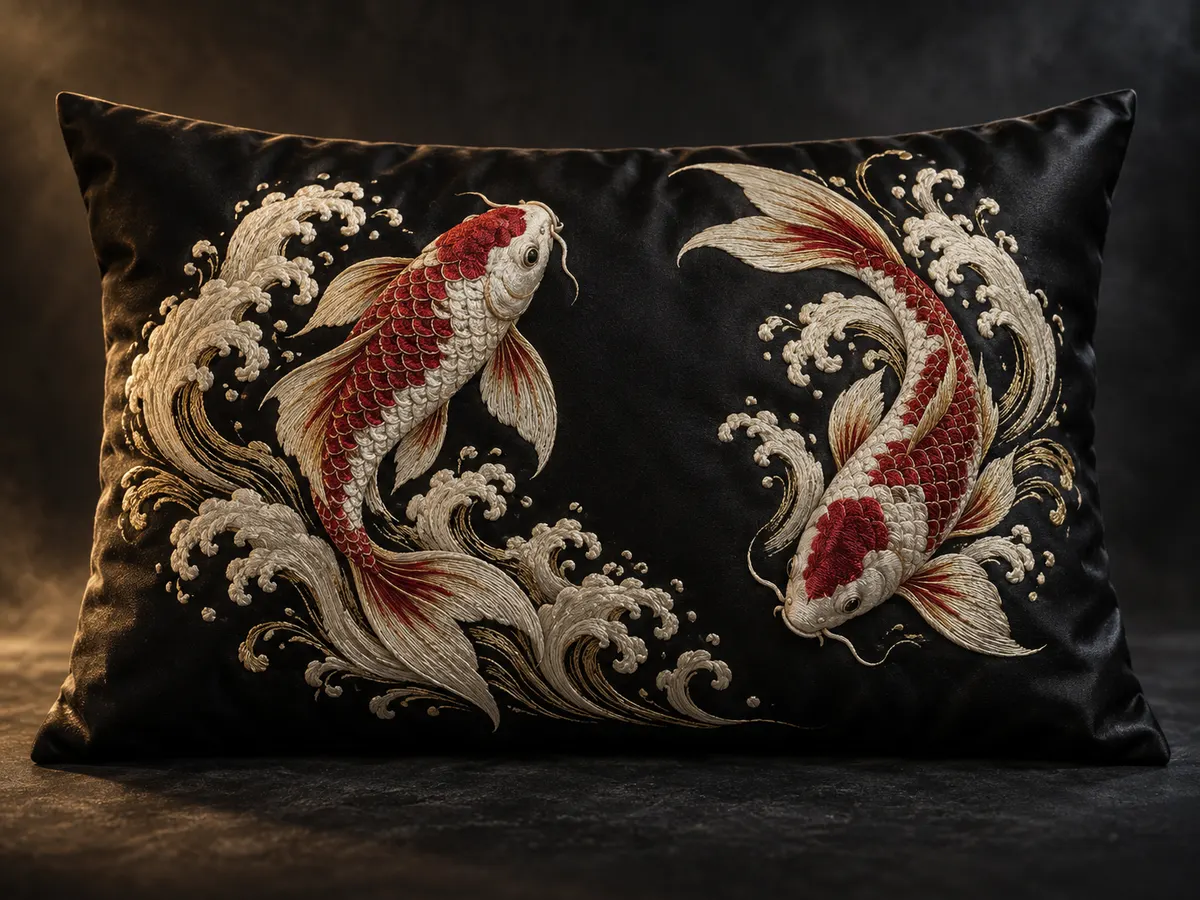
In the Dragon Gate account, the carp swims upstream, reaches the falls, and leaps. That sequence supports an association between upstream movement and effort or ambition. A koi embroidered beside rising waves can suggest the struggle in the story, especially when the composition makes its direction easy to see.
A downstream fish does not have an equally documented, fixed opposite meaning in the sources here. “Downstream means letting go” is a modern tattoo convention, and artists and wearers may interpret it differently. Even an upward-facing fish on a jacket can appear to move sideways once the garment folds or the wearer turns. Direction works best as one clue in the overall artwork, rather than a test with a single correct answer.
If the koi and dragon legend is what draws you to a piece, look for a composition that communicates movement to you. If you prefer a fish turning through water, you do not need to assign its direction a traditional meaning. You can choose the image for how it looks and say plainly what it means to you.
Where Koi Motifs Work on a Garment
For koi fish jackets, consider the back as a whole before studying the embroidery up close. Can you distinguish the fish from the waves? Does the artwork still have a clear shape at a few steps' distance? Sukaizen's Dragon & Koi Reversible Sukajan Jacket puts koi, water, and floral accents on its pearl-ivory side, where vermilion, rust, gold, and sage have room to separate. Its other side is scarlet with a dragon. That switch changes the subject as well as the color.
Small placement offers a different kind of usefulness. The Koi Stream Pocket T-Shirt places two tiny washed-blue koi curves beside the left chest pocket. Its images are generated design mockups, so use them to judge the intended scale and position rather than to inspect a finished piece of embroidery. If placement is your deciding factor on any koi fish shirt, check the available product information for the actual artwork and garment before choosing.
Choosing a Koi Piece: Jacket, Hoodie, Tee or Denim
Choose by how much of your outfit you want the fish to occupy. A jacket gives a koi scene the broadest canvas among these options. Sukaizen's $339 Dragon & Koi Reversible Sukajan Jacket has a pearl-ivory rayon satin koi side and turns to a scarlet dragon side. A reversible koi jacket is worth considering when you want both subjects and can picture yourself wearing each side. If only one appeals to you, judge the purchase on that side alone.
A koi embroidered hoodie keeps the main artwork on the back while offering a smaller detail at the front. Sukaizen's $149 Koi Embroidered Hoodie is a black, cotton-rich loopback French terry pullover with two koi in indigo, ivory, vermilion, and silver-blue on the back, a small chest mark, and a relaxed drop-shoulder fit. It suits someone who wants a prominent image that is less visible face-to-face than a large front graphic.
For a smaller accent, the $55 Koi Stream Pocket T-Shirt uses two fish beside the pocket; remember that its product images are generated design mockups. For artwork on the lower half of an outfit, the $219 Koi & Wave Japanese Embroidered Jeans use ecru 12-14 oz cotton denim in a relaxed straight-leg cut, with rust, antique gold, ivory, and sage embroidery. The $269 koinobori carp-streamer sukajan is another distinct choice: it shows carp windsocks on a pole, so its subject is streamers rather than swimming fish. Sukaizen uses Tajima machines and polyester thread for its embroidery.
Styling Koi Embroidery Without Overdoing It
Give the motif a clear place in the outfit. With a detailed koi jacket, a plain shirt and trousers let the back artwork carry the attention. You can repeat one thread color in another item if you enjoy a coordinated look, but an exact match is unnecessary. The goal is to make the fish easy to see when you want it seen.
Frequently Asked Questions
What does a koi fish mean on clothing?
A koi can suggest perseverance and achievement through the Dragon Gate story, in which a carp swims upstream, leaps the falls, and becomes a dragon. The Cleveland Museum of Art also documents carp imagery on a Japanese gift cover suited to celebrating an achievement. A modern clothing design may draw on that context, use the fish primarily as a visual motif, or carry a meaning chosen by its wearer. Look at accompanying waves, a dragon, or streamer shapes before assuming which reference the design intends.
Do koi fish colors have fixed meanings in Japan?
No single set of color meanings applies to every koi design in Japan. Nippon.com documents a particular convention for koinobori: black and red carp represented family members in one period, and later red and blue took on different family roles. That does not make red a universal symbol of love or blue a universal symbol of calm. Meanings assigned to koi colors in tattoos or contemporary artwork vary by artist. If you choose a color for a personal reason, describe it as your interpretation.
What is the difference between koi and dragon motifs?
In the Dragon Gate story, the carp strives toward the falls and becomes a dragon after leaping them. That gives the two figures different places in the same narrative: the swimming carp can evoke the effort, while the dragon can evoke the transformation. A garment may show one, both, or neither in a literal retelling. The Dragon & Koi reversible sukajan uses a koi scene on one side and a dragon on the other, so choosing which side to wear also changes the image that leads the outfit.
Is wearing koi fish clothing cultural appropriation?
Wearing a koi design is not, by itself, enough to determine cultural appropriation. How you describe and use the imagery matters. Learn whether a design shows swimming carp, a Dragon Gate reference, or festival streamers, and avoid presenting a personal color or tattoo interpretation as a rule of Japanese tradition. You can appreciate the artwork while being accurate about its references. If a particular piece makes a cultural claim, assess that claim on its own terms rather than assuming every koi motif has the same history.
How do you style a koi embroidered jacket?
Style a koi embroidered jacket by letting its main artwork set the level of detail for the rest of the outfit. A plain top and simple trousers give a large back motif space to read. If the jacket is reversible, try complete outfits with both sides; the colors and subject may call for different combinations. Check the design from the front and back, since a jacket that looks quiet face-to-face may carry most of its artwork behind you. Choose other patterns only when you like how they look alongside the fish.
Conclusion
The most useful way to choose koi fish clothing is to separate a documented reference from a meaning you give the design yourself. The Dragon Gate story offers a grounded reading of effort and achievement; color charts and downstream meanings need more careful labels. Then make a practical choice: decide how visible you want the motif, and inspect its placement on the garment. A piece that works at your preferred scale will be easier to style on your own terms.


